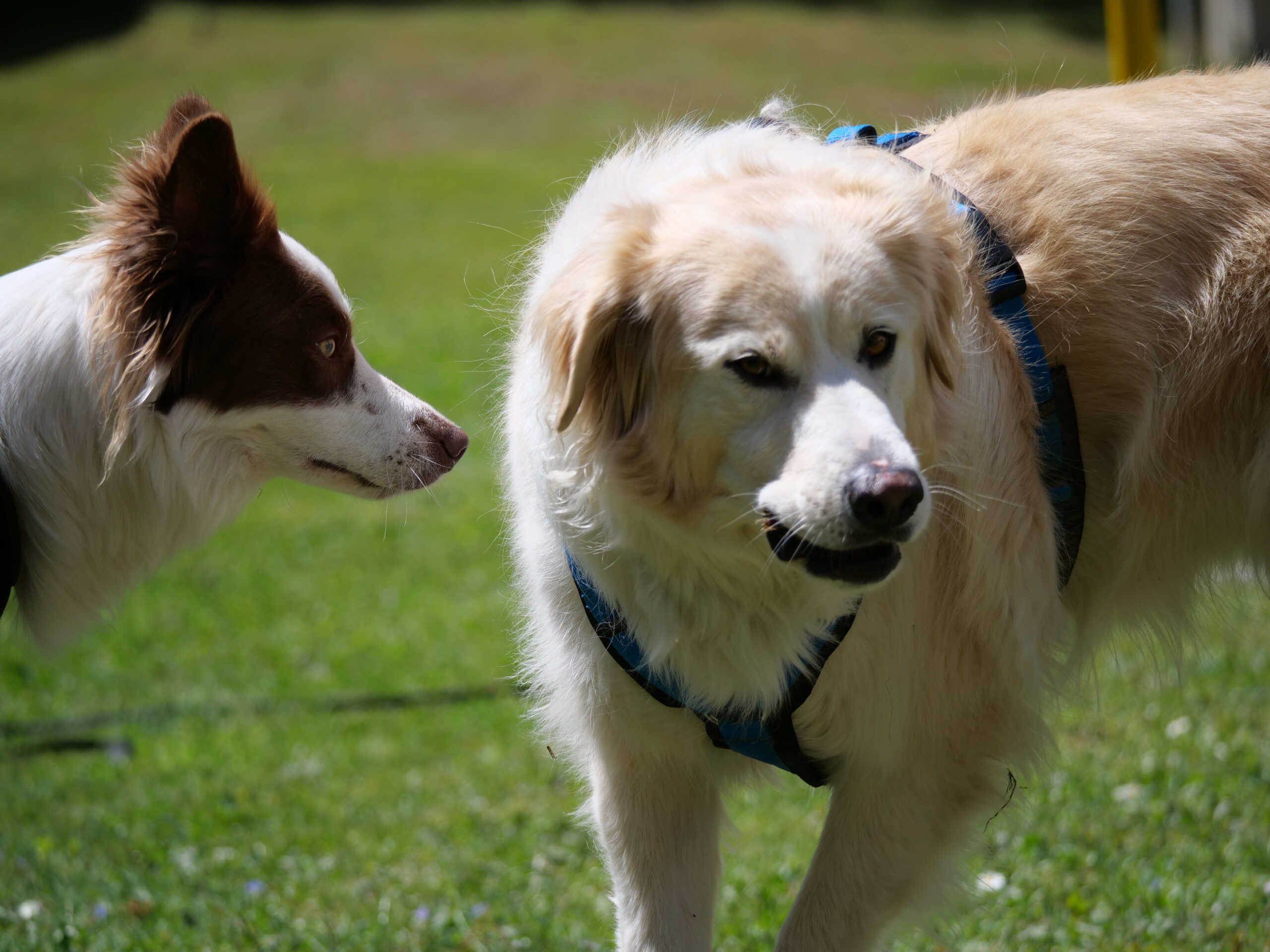
The dog comfort zone is a key concept in understanding canine behavior. In this article, we explore what a dog’s comfort zone is, how to recognize stress and communication signals, and why staying within this zone is essential for learning, emotional safety, and behavior modification.
The concept of a comfort zone is the foundation of any work on canine behavior, whether it involves reactivity, fears, or overexcitement.
As explained in this article on behavioral rehabilitation, understanding and respecting a dog’s comfort zone is essential for successful desensitization work.
Like all living beings with a developed nervous system, dogs have different zones and survival strategies when faced with perceived danger.
The « 3Fs »
Let’s start with the concept of the “3 Fs”—Freeze, Fight, Flight. This model was developed in the 20th century by researchers such as Walter Bradford Cannon, and later expanded upon by John Paul Scott & John L. Fuller, as well as Robert and Caroline Blanchard.
The “3 Fs” describe the possible responses to stress: an animal may flee (flight), fight (fight), or become immobile (freeze). These responses are not conscious choices, but automatic neurobiological reactions. Very often, an animal will first freeze before escalating to flight or fight.
The choice between Freeze – Flight – Fight is neither random nor voluntary. It results from an automatic assessment of danger shaped by evolution, physiology, and individual experience. Several factors are evaluated simultaneously, such as the immediacy and distance of the threat, the animal’s physical abilities, the evolutionary history of the species, past experiences, the animal’s hormonal and physiological state, and the surrounding environment (for example, whether escape routes are available).
From an evolutionary standpoint, fight is a costly and risky strategy. It is rarely an “aggressive choice,” but rather a last-resort survival response when all other options are blocked.
The Comfort Zone
Now that we understand the “3 Fs,” let’s take a step back and look at when these responses are likely to occur.
Just like the “3 Fs,” all animals with a developed nervous system have what we call a comfort zone. The comfort zone refers to an animal’s emotional state when confronted with a stimulus. While the concept is often used for stimuli that provoke negative reactions, it also applies to situations that elicit overly positive reactions (such as excessive excitement). In those cases, the “3 Fs” adapt to the context rather than applying literally.
For clarity, we will focus here on stimuli that trigger negative reactions, using the dog as our example—though the same principles apply to overexcitement.
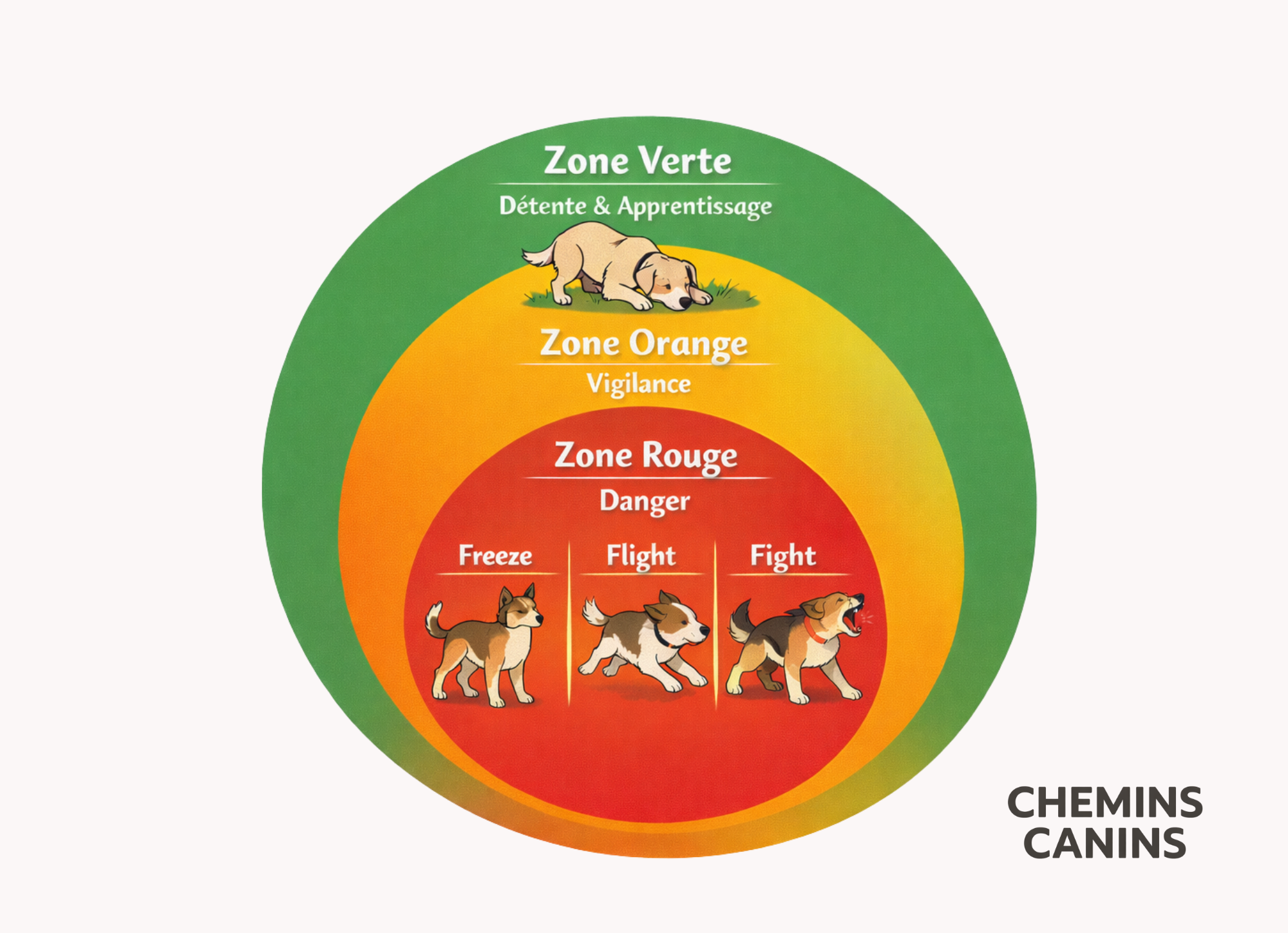
We can visualize the comfort zone as several sub-zones, represented by color codes:
The red zone 🔴
The red zone is the dog’s danger zone and is the closest zone to the dog. In this zone, the “3 Fs” take over. The dog can only respond through one of these three automatic and involuntary strategies. Rational thinking is no longer possible—only action.
From a communication standpoint:
- A dog inclined toward flight may show a low posture, weight shifted backward, ears pinned back, tail tucked, avoidance of eye contact, lifted lips, growling, or fleeing.
- A dog inclined toward fight may shift weight forward, charge toward the perceived threat, raise the hackles, hold ears forward, bark, bare teeth, snap, or lunge.
⚠️ A dog that initially tries to flee may switch to fight if escape feels impossible.
The orange zone 🟠
The orange zone is the dog’s vigilance zone. For clarity, it can be divided into two sub-zones:
- Dark orange (closer to red)
- Light orange 🟡 (closer to green)
In the orange zone, the dog is still capable of learning and thinking—although the closer they are to red, the less available their brain becomes.
Dark orange zone:
The dog focuses most of the time on the triggering stimulus but can briefly turn toward their handler before refocusing on the trigger. They are only minimally available to their human, may respond inconsistently to cues, and often accept treats but struggle to fully disengage to take them.
Light orange zone:
The dog monitors the trigger occasionally, checking its movement or distance, but can turn toward their handler for several consecutive seconds. The dog can perform known behaviors without hesitation, takes treats normally, and may engage in activities such as sniffing while still keeping an eye on the trigger.
In the orange zone, the dog’s posture is generally relaxed, though alert. You may observe brief breath-holding, a temporarily stiff or raised tail, or momentary tension—followed by a return to relaxation.
The green zone 🟢
The green zone is the dog’s true comfort zone. Here, the dog is fully available for learning and new experiences.
From a communication standpoint, the dog appears relaxed: a loose, naturally wagging tail, normal breathing, and engagement in activities like sniffing or playing, without concern for the trigger.
A Dynamic System
These three zones are not fixed in time or space. They fluctuate depending on many factors, such as:
- the dog’s physical condition (for example, pain on certain days),
- the environment (visual barriers like trees or walls),
- the dog’s emotional load for the day,
- the nature of the trigger (one dog or several, leashed or off-leash, staring, barking, moving away, etc.).
As explained in this article, when we aim to modify behavior while respecting the dog’s emotional state, we try to stay as much as possible within the green–orange zone, where learning can occur. Specific exercises should be carried out in this range.
In contrast, when a dog is in the red zone, emergency management strategies may help prevent escalation and further sensitization—but these are not training solutions. At that point, the dog is no longer emotionally able to self-regulate.
Conclusion
Understanding your dog’s comfort zone means learning to read their emotions before they overflow. It means recognizing that behind every behavior lies an emotional state, and that your dog is always doing the best they can with the resources available at that moment.
By identifying which zone your dog is in, you can adapt distances, expectations, and exercises to remain in a space that supports learning and emotional regulation. Working in the green and orange zones allows your dog to think, adapt, and progress without feeling threatened.
Respecting a dog’s comfort zone does not mean avoiding challenges altogether—it means supporting the dog in a progressive, safe, and emotionally respectful way. This is a fundamental pillar for building lasting trust and helping dogs develop greater confidence and calmness in their environment.
No responses yet